The Kodak Pixpro FZ55: A Lovely Little Camera Built on Fragile Foundations, Our Honest Review
- May 21
- 4 min read
By Juan Correa
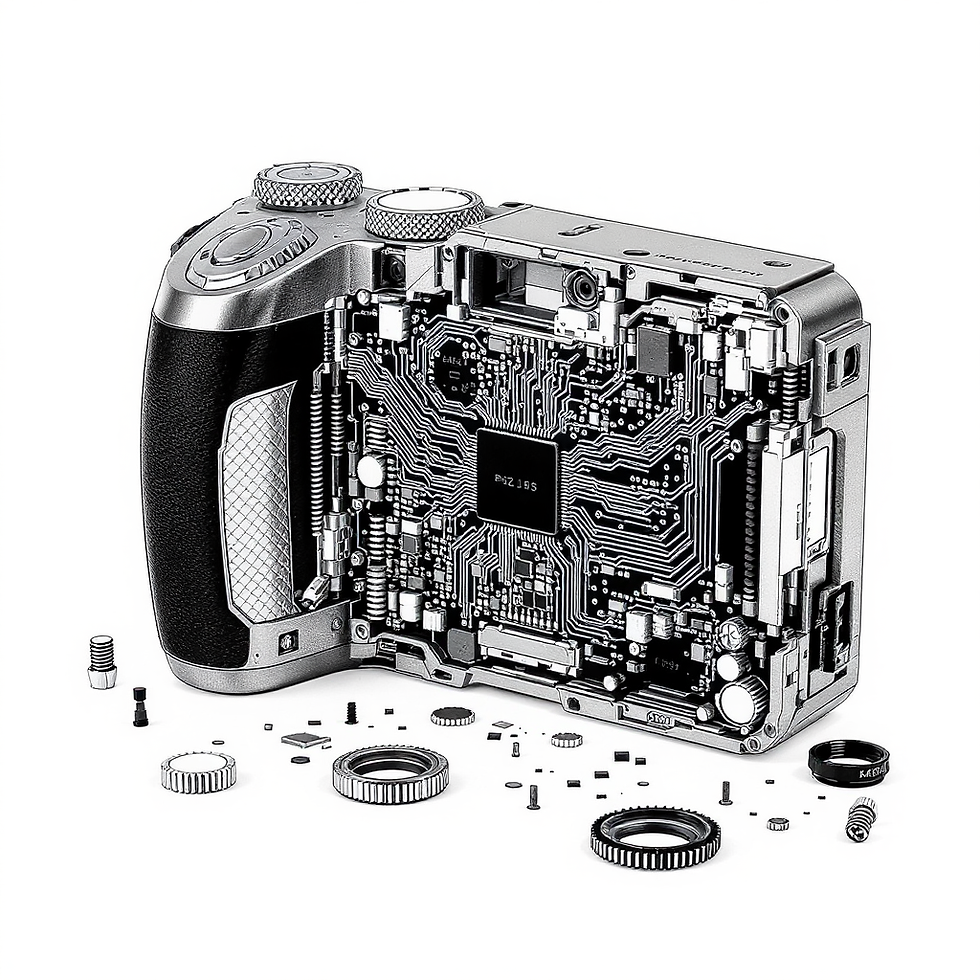
There is a particular kind of sadness reserved for compact digital cameras.
Unlike larger photographic systems — DSLRs, film cameras, even mirrorless bodies — point-and-shoot cameras often disappear quietly. They are dropped into drawers, abandoned after an error message, replaced instead of repaired. Their failures rarely feel dramatic. They simply stop extending their lens one day and never recover.
My Kodak Pixpro FZ55 recently joined that long digital graveyard after approximately a year and a half of regular use. The final message displayed on-screen was one many Pixpro owners have likely encountered before:
“Lens blocked. Please restart camera.”
Restarting no longer helped.
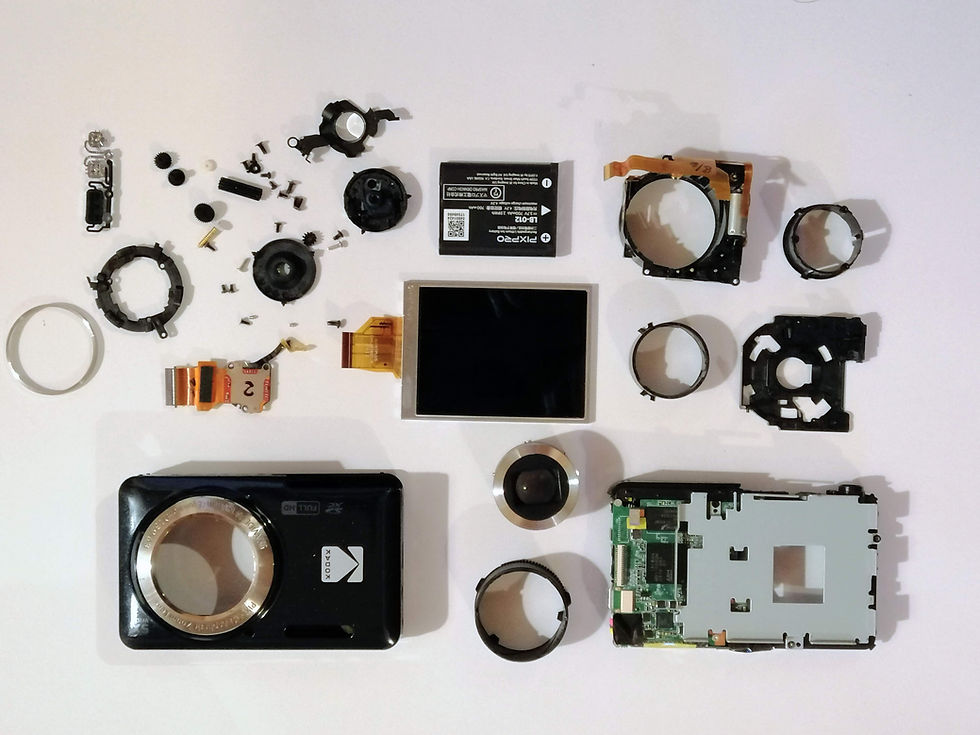
Repair shops declined the repair almost immediately. The economics of modern compact cameras make servicing difficult to justify; labor costs alone can rival the value of the camera itself. So instead of sending it away, I did what many curious photographers secretly want to do when technology fails: I opened it. What followed was less an attempted repair and more an accidental autopsy.
A Tiny Monument to Miniaturization
The first surprise was just how much engineering exists inside the FZ55.
Compact cameras occupy an unusual space in photography because their modest external appearance hides an astonishing degree of mechanical and electronic complexity. The Pixpro is no exception.
Inside its lightweight shell sits:
a retractable multi-stage zoom lens assembly,
stacked reduction gears,
ribbon cables folded with origami-like precision,
a CMOS imaging sensor,
a Giantplus FM1367A01-B display,
and a processing board powered by ARM and Zentel components.
Everything inside the camera feels compressed to the absolute limit of manufacturable space.
And for a moment, disassembly transforms frustration into admiration.
The FZ55 is, objectively speaking, an impressive little machine.
The camera’s usability reflects that same thoughtful engineering. During its life, the Pixpro consistently proved enjoyable to shoot with:
menus are straightforward,
ISO adjustment is accessible,
program modes are intuitive,
startup time is acceptable,
and operation feels pleasantly uncomplicated.
Importantly, it also preserves something many modern smartphones have lost: photographic friction.
The FZ55 does not aggressively computationally optimize every image into polished perfection. Its photographs retain texture, imperfections, and the small inconsistencies that make compact digital cameras emotionally appealing in the first place.
This is partly why cameras like the FZ55 have found new popularity among younger photographers chasing the aesthetics of early digital photography. They occupy a sweet spot between convenience and imperfection.
Unfortunately, they also occupy a dangerous sweet spot between affordability and durability.
The Problem Beneath the Shell
Once the admiration fades, another reality becomes unavoidable.
Nearly every critical mechanical component inside the FZ55 is plastic.
This is particularly concerning around the camera’s most failure-prone area:the retractable lens mechanism.
The telescopic zoom assembly relies on an intricate network of miniature plastic gears, rails, and guide components operating with extremely small tolerances. The system must extend and retract flawlessly every time the camera powers on or off.
And that precision appears fragile.
A small amount of dust, slight wear on a gear tooth, or minimal misalignment may be enough to trigger the infamous lens blockage error that effectively bricks so many compact cameras.
This is not unique to Kodak, of course. Modern compact cameras across many manufacturers increasingly prioritize:
low cost,
reduced weight,
aggressive miniaturization,
and simplified assembly.
The result is a category of devices that can feel mechanically disposable despite containing remarkably sophisticated engineering.
The tragedy is that the FZ55 is not failing because its concept is flawed.
It fails because its weakest mechanical system is also its most essential one.
The Compact Camera Contradiction
There is an irony at the center of modern point-and-shoot design.
These cameras are marketed as portable everyday companions:small enough for pockets,light enough for travel,simple enough for spontaneous use.
Yet internally, many are built around mechanisms so delicate that ordinary environmental exposure becomes a threat.
Dust, minor impacts, or repeated lens cycling can gradually compromise systems that are effectively impossible to economically service.
This creates a growing divide between emotional value and practical value.
Because despite its limitations, the FZ55 was genuinely likable.
It was not particularly fast.Its autofocus occasionally hesitated.Its low-light performance remained modest.And no one would mistake it for a professional tool.
But it possessed something increasingly rare:personality.
The camera encouraged intentional photography in a way smartphones often do not. Carrying it changed the rhythm of image-making. One photographed differently with it.
And that matters.
A Different Path Forward
Perhaps the most interesting realization after dismantling the Pixpro is that compact cameras may not need to pursue full automation so aggressively anymore.
The contemporary resurgence of interest in point-and-shoot photography is not driven solely by convenience. In fact, much of the appeal comes from tactility, limitation, and interaction.
Which raises an interesting possibility:
What if future compact cameras simplified their most failure-prone mechanisms by reintroducing manual interaction?
Instead of fully motorized telescopic systems:
manually extending lenses,
twist-to-zoom mechanisms,
mechanical deployment locks,
or hybrid manual controls
could dramatically improve durability while reinforcing the tactile experience many photographers already seek.
Ironically, a partially manual compact camera might not feel outdated at all.
It might feel refreshing.
Final Thoughts
The Kodak Pixpro FZ55 ultimately leaves behind a complicated legacy.
On one hand, it represents impressive engineering miniaturized into an affordable and approachable photographic tool. Its popularity is understandable. The camera is enjoyable, accessible, and capable of producing images with genuine character.
On the other hand, its long-term durability raises difficult questions about how modern compact cameras are designed, manufactured, and valued.
After dismantling mine, I found myself simultaneously more impressed by the camera’s engineering and more disappointed by its fragility.
Perhaps that contradiction defines much of modern consumer technology:astonishingly sophisticated devices built with increasingly temporary lifespans.
The Pixpro FZ55 deserved sturdier bones.
Because underneath the plastic gears and fragile lens assembly was a camera people truly wanted to keep using.


Comments